
Cedar Pergolas
Our Cedar Pergolas have been our most popular pergola design over the years.
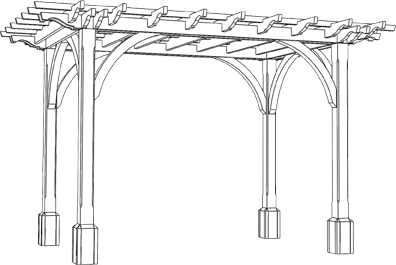
Main benefits of the Post and Beam Pergola:
* Clean, simple, graceful design
* Fully customizable to any size or shape
* Choose from 4x4, 6x6 or 8x8 posts
* Choose your options like brace style, beam size, boots
* Choose electric options like outlets and switches cut into the posts
* All intersections are notched for old world craftsmanship and joinery
* Choose any finish such as clear sealer, semi transparent or solid color stain
* This pergola can be Attached to your home
* Designed for easy assembly with minimal tools and experience.
* No exposed fasteners – Mortise and tenon craftsmanship
Private shade room

Private Shade Room
Notice the vertical flutes machined into the 6x6 post? That is an example of a customization that the web site pricing engine doesn't offer. If you can think of an option you would like on your pergola, suggest it. We will offer you a price for the customization. We put a darker stain in the flutes to accentuate them.

Private Shade Room
Notice the two dark circles above the post? This is what we call a Lincoln Log Joint. Think of it like a master link in a bicycle chain. We machine a peanut shape out of the back of the two mating boards, then create this Link out of a South American hardwood known as Ipe. It is an extremely hard, durable lumber which will hold this joint firm forever. The radius of the arches represent perfect circles.

Private Shade Room
We anticipated a gap between the ends of these two braces, so copper flashing seemed like a good solution. Notice that the dental-work above the joint was aligned to be centered. Attention to these subtle details are what we excel at.

Private Shade Room
The posts are evenly spaced along one side. On the other side, the posts align with the stone wall. This can only happen with the involvement of the customer who must relay their desires specifically. We don't mind customizing your pergola because we built them one at a time, to order.

Private Shade Room
The house is a contemporary, so instead of a Victorian/Greek/Roman architecture, we felt it needed a more subtle cut and selected the Japanese cut which some people might call Scandinavian.
New York Shade Room

New York Shade Room
This pergola may appear simple, but the area it fits into is very irregular and required lots and lots of measurements and correspondence. It's freestanding, but has only three posts and IS connected to the house where the fourth post would have been. The project was tedious because of it's complexity, but working with the client was a pleasure because he knew exactly what he wanted and was good at expressing it.

New York Shade Room
Clear cedar lumber was selected. Clear Western Red has tight, complex grain which glows with reflectivity. The darker sections of the cedar wash into the lighter sections like two rivers converging over rapids. The fit and finish of this pergola was equal to a fine Japanese temple.

New York Shade Room
This custom bracket was created to receive and support the two cedar beams. As it turned out, the stucco of the house was very irregular, but with some careful grinding, our install team was able to make a perfect fit.

New York Shade Room
The spacing of the rafters brought the last rafter into a collision with this copper downspout. We moved the rafter over a couple inches which meant custom notching array in the beams and purlins. We made the cutout for the down spout at an angle in the factory; All thanks to careful measurements supplied by the homeowner.

New York Shade Room
In this photo you see the large arched gussets which are cut from 6" x 12" stock, lagged bolted to the side of the clear cedar 8x8 with chamfered corners. We make the dowels which conceal the hardware. Notice that the top of the post is haunched to make a ledge for the beams to rest upon. We are proud of our details.

New York Shade Room
To further point out the details of this pergola, please notice the bottoms of the rafters have a gentle arch cut into their bottom edge. This is to allow access to the window should it need replacing down the road of time. The face rafter is not arched. You can't buy this at a Big Box Store.

New York Shade Room
Lastly, please notice what we call the 'boot' which slides over the bottom of the post. It gives the post some needed aesthetic weight to counter balance the top, similar to the leg of a Clydesdale horse. It's job is to conceal the ABU66Z mounting bracket. To the bottom of the boot we attach nylon glides: You can just barely see them. Their job is to prevent water from wicking up into the end grain of the boot.
Attached Cedar Pergola

Attached Cedar Pergola
This is a large custom home in upstate New York. Stone patios absorb the suns rays and turn into outdoor ovens. This South facing patio would typically be thrifty degrees hotter then the sun. A shade solution was needed. The tall windows required a tall pergola. A larger pergola was not an option due to traffic patterns on the patio.

Attached Cedar Pergola
Our install team removed the crown molding below the soffit and squeezed the 5.5 inch tall ledger into place. The ledger is notched to receive the rafters. The rafters are notched to fit into the ledger, so the bottoms of the rafters are flush with the bottom of the ledger. Notice that the shade system is lower on the exterior then the interior. This allows the water to run off away from the house.

Attached Cedar Pergola
It's hard to see, but the color of the rafters matches the color of the house and the color of the posts and beam match the trim color. Here we see Mark about to extend the Easy Shade Canopy.

Attached Cedar Pergola
The dining table is preventing Mark from walking straight through the center of the pergola, but the length of the crank handle allows Mark to open the shade with ease. The system is designed in such a way that it cannot bind up.

Attached Cedar Pergola
This pergola is quite tall, but as you can see, the shade system works well in creating shade. It's essentially a massive umbrella which adds architectural detail to the home.

Attached Cedar Pergola
Mark is cranking the handle clockwise to tighten the shade hardware and lock it's current position. A nice feature of this shade system is that you can lock in any position you like. Open the shade to the position you're happy with and tighten the crank. Very simple. Very easy.
Poolside Post and Beam Pergola

Poolside Post and Beam Pergola
Placing a pergola at the head of a pool is classic. The structure is beautiful and practical, but when your focus shifts to the reflection of the pergola in the water something magical happens which is hard to put into words. Lighting a pergola of this natural is a great idea. Some people cut the lights into the patio and cover them with tempered glass. Others put the light fixtures up high and shine down. Either way... Beautiful.

Poolside Post and Beam Pergola
The span from center to center is twenty feet in width. In depth it's ten feet. The height is foot and six inches to the bottom of the beam. The posts are 8x8's. We worked hand in hand with landscape architect Catharine Cooke of Spring Lake Design.com.

Poolside Post and Beam Pergola
Sometimes were refer to 1.618 Fibonaccis golden spiral when designing pergolas. We also refer to classic architectural orders of the Greeks and Romans. Simple design school teaches us that squares are formal and rectangles are informal. We've studied Feng-shui and even Vastu Purusha Mandala. We draw knowledge from all of these sources when assisting our customers in effort to build perfect pergolas, but in the end, we always go with what the customers wife says.

Poolside Post and Beam Pergola
Looks inviting. Imagine the serenity of lounging in this most private setting. God bless America.

Poolside Post and Beam Pergola
Often times, when we get to this point, we take a picture. It's because this structure is beautiful even in it's incomplete form. This is known as a colonnade because it has two posts, but some might call it an arbor. It's plum and level and it provides form which is in contrast to its natural setting. These should be more popular.

Poolside Post and Beam Pergola
We were happy with the proportions of this pergola. The 8x8's really make a statement. The arched gussets are five and a half inches think and together with the posts, they say: "Get used to us. We're going to be here for a very long time.".
Ocean Pergola

Ocean pergola
A fiberglass pergola derives its strength from its firm connection to a concrete footing or a concrete slab. For that reason, they don't do so well on decks. A post and beam pergola is different. It's strength comes from the connection between the post and the beam. Think of it like a kitchen table. It's strong independently and doesn't require connection to the kitchen floor.

Ocean pergola
What's most noticeable here is the quantity of purlins. We typically space our purlins at 16" inches from center to center, but in this case, the customer wanted more. These purlins appear to be nine inches on center. This creates additional shade and beauty. Pay for it once. Enjoy it forever.

Ocean pergola
What people don't think about when considering a pergola is the appearance of the pergola at night. Or is it the appearance of the starry night framed by the pergola? The moon casts shadows on the deck all night which are kind of mystical. This pergola is an outdoor room... With a view, day and night.

Ocean pergola
Please notice that there are beams in the depth aspect which span from the side of the house and out beyond the post. These beams do not support anything. They are purely cosmetic, but they complete the enclosure of the outdoor room. They also provide an attachment opportunity for gussets (braces) which arch toward the house. These are also purely cosmetic.

Ocean pergola
This photo shows the ledger board attached to the house. Notice that the screws are right under the notches - This is so the rafter conceals the screws! All the intersections are notched: Beams are notched for rafters. Rafters are notched for beams AND purlins. Purlins are notched for rafters.

Ocean pergola
Here you get a glimpse of the view and another look at the post and the gussets. The beams have deep notched which half lap over each other for a flush finish. We love this stuff.
Wedding Pergola

Wedding Pergola
It's important that the pergola be built to the same scale as the house. While we prefer short pergolas, sometimes the setting requires extra head room. With this in mind, please don't forget to send us pictures of where you want your pergola. It will help us to a great extent.

Wedding Pergola
This pergola has a wide stance, is tall and is built with appropriately substantial components. It's also outfitted with outlets switches, lights and speakers. I really respect the owners decision to grow Wisteria plants over the top. Notice the cut outs in the patio for plantings.

Wedding Pergola
This close-up shows the high level of detail in the 8x8 posts. The flutes were cut with a CNC router. They begin and stop above and below the gussets, outlets, switches and boots. You might imagine our robot making these cuts efficiently, but it turned out to be quite a labor intensive project. Fluting of posts is not a standard option, but we customize almost every pergola, so be sure to inquire if you are interested.

Wedding Pergola
Without the pergola, the patio would not appear nearly as inviting. Pergolas were all the rage during the victorian era of the late nineteenth century. Around the 1920's the "Naturalist" movement gained popularity among garden designers and most garden structures were removed. With all we've learned about the damaging rays of the sun, I don't think we'll be repeating that bit of history.

Wedding Pergola
We have worked for some prominent families and we look forward to working with you and your family. Please consider giving Baldwin Pergolas the opportunity to impress you and your friends.

Wedding Pergola
The cutouts in the patio allowed the customer to grow wisteria up the legs of the pergola. Wisteria blocks the sun in the summer, but allows sunlight to enter the house in the winter when all the leaves fall off.
Cedar Pergola Assembly Video
Details which make Baldwin the obvious choice

Our planning and design team
Max Baldwin founded Baldwin Pergolas over 30 years ago and is considered a leading expert in the industry. With decades of experience you can count on Baldwin to get the job done right the first time! At Baldwin we care and we have an experienced design and sales team that is prepared to guide you through the process of creating your perfect pergola. Mike Hurlburt is our project manager and is ready to help you design and build your dream pergola TODAY!

The materials we use
Western red cedar is one of the most challenging materials to work with because of it's wide variety of colors, grains and textures. We must be careful to include boards of varying color because that's the true beauty of a cedar pergola, but meanwhile we're well aware that nobody wants their structure to include harshly contrasting pieces. People are always complimenting us on the beauty of the lumber, but we cannot take any credit for that; We just arrange what God has given us.

We sell Direct!
Our competition has a commission only sales force which receives almost half of the money people pay for their structures. So if you pay $8000 for a pergola, the company actually making it is getting only $4000. You can expect to be disappointed with the quality of lumber, hardware and craftsmanship. There's just no way around it. You will not be getting your moneys worth if you shop anywhere else.

Notched intersections
and plugged screw heads
We carefully design and notch our pergolas to make the structure more beautiful, stronger and easier to assemble. You just match the notches up and it slides together. No measuring is required. We include mahogany plugs to cap the screws. Mahogany is another of the woods that last for decades outdoors. The worker in this photo is inserting plugs to complete an installation.

More shade
We space our cedar rafters and purlins approximately 16" inches on center. Online only pergolas are typically 24" on center. Our beams are typically 2x8, rafters 2x6, purlins 2x3. This network creates a cooler, shadier patio area, but more shade can be obtained by growing a vine, installing an easy shade, an easy curtain, or ordering our custom outdoor drapery.

Concealed wires
We have the ability to channel our 6x6 and 8x8 posts to conceal wires for lighting or speakers. The channel includes a shoulder cut for our wooden concealment strip to nestle into. We also cut a channel in the top of the post so then the wire reaches the top of the channel it can turn and run between the beams as required.

We Customize!
Baldwin Pergolas is a full blown custom woodshop with modern machinery and skilled workers. We love to make people happy so rather then tell you all the things we don't do, we'd rather say "
Yes, we can do that!". We want to be the company that delivers your dreams. Tell us what you want done and allow us the opportunity. You will surely be impressed.
Options - Decisions you will need to make when ordering

Attached or Freestanding?
Our typical Attached Cedar Pergola consists of a set of main beams running parallel to the house as well as a ledger that connects to the side of your the house. They require less posts, less footings and ultimately a lower price tag. All that being said, freestanding pergolas are still more popular.

Depth and width
Our pergolas are available in standard sizes for ease of pricing, but we can custom tailor the size of your pergola down to the exact inch you require. Our order form makes this simple, but you'll need to tell us exactly where you want the centers of your posts. The best way to do this is to place pots or plates where the posts will be. Measure. Custom drawings will be created for your review and approval. 4x4 posts have a 5.5 x 5.5" boot. 6x6 Posts have a 8.5 x 8.5" boot. 8x8 Posts have an 10.5 x 10.5" boot.

Height
We encourage our customers to design short pergolas because they look better and provide more shade. A perfect height is seven and a half to eight feet. Many projects require taller posts for a variety of reasons, but please keep in mind that we are humans and twelve foot tall pergolas look ridiculous. In this photo, you can see two pergola heights: 8 foot and 10 foot tall. Notice the man in the background: You can see that the scale of this job is just too tall.

Choice of post size
When we started building pergolas back in 2003, everyone wanted 4x4 posts. As soon as we made 6x6s available as an option, everyone wanted them. Along the way we've done a lot of pergolas with 8x8 posts which are the most impressive.
The thickness of the post has an effect on the thickness of the gusset (brace), so these components scale with each other. Also consider the scale of the setting. Is the home large? What is the scale of other architectural details in the yard?

Rafter tails
The cut on the rafter tail determines the architectural style of the pergola. It makes a big difference in the look of the pergola. If you would like a custom rafter tail, we can do that, just send a drawing or a photo. We'll design an proof and once you approve it, it's yours. We use solid carbide router bits and a computer controlled router to make the cuts, so they all come out exactly the same!

Gussets AKA Braces
We considered removing this as an option. Almost 100% of people choose the arched gusset. It embodies the classic architectural order defined by the Romans thousands of years ago: The Roman Arch. We have done a limited number of pergolas with the Craftsman style gussets and they can be just as beautiful. Another name for Craftsman style is Mission style which gained popularity in the 1920s.

Color selection
Most cedar pergolas get coated with Olympic Maximum, Cedar natural tone Sealer because it blocks the ultra violet rays and includes a wax which limits moisture fluctuation. If you want a solid color we will apply Sherwin Williams Woodscapes solid color stain, but if you don't love the natural wood, why not choose fiberglass? We often apply a coat of either white wash or gray, weathering stain. Each of these coatings tint the pergola and still show the grain and texture of the cedar. It's a nice effect, but it's not for everyone. Our pergolas are built with a designers eye for quality, fit and finish.

Lumber grade
We hand-select the finest Western red cedar boards for our pergolas. Both grades of lumber have the same quality and integrity.
Our knotty grade cedar boards are cut from trees which were planted in the United States about 80 years ago. They trees had branches, so the boards have knots. We carefully inspect every inch of every board for defect and use only good ones for pergola parts.
The photo on the right shows high quality, furniture grade, old growth, cedar. The grain is very tight and straight. If left untreated it will weather to a beautiful gray in about a year. It has only a few small knots.
Shade systems
Overhead fabric sun-shades have become more and more popular in recent years. Our preferred shade consists of one large sheet of fabric which extends and retracts. More information is available in our Shade Systems section of the web site.

Installation
Our pergolas were specifically designed to make installation easy. If a task can be done at the factory, it gets done at the factory. After completing thousands of installations, we can confidently say that no job is every easy. Unexpected site conditions are the primary reason. We bring every tool known to man and use most of them during the installation. You will see installation service on the order form, but it is only available if you live within 100 miles of our factory located in 06457, excepting special conditions.

Terminology - Click expand

Footing: A concrete anchor which holds the pergola to the Earth. They need to be deeper than the frost line, but also large enough and deep enough to hold the pergola to the Earth during a strong wind. Footing size should never be less the 42" deep and 12" diameter.
Pier: This in a small stone wall on which a pergola can be mounted. The pier is always supported by a footing or a concrete slab. If building a stone wall or pier, it would be wise to anchor a 5/8" threaded rod into the footing to anchor a pergola.
Post: The 4x4, 6x6 or 8x8 vertical member which supports the pergola top. We chamfer our posts in a way which embodies the most classic architectural craftsmanship.
Boots: This is a box of trim which gives aesthetic balance to the pergola and also conceals the post mounting bracket.
Gussets: Some people call them braces which is perfectly appropriate. Regardless of what you call them, gussets provide diagonal or lateral strength between the post and the beam. These are what keep the pergola from blowing over.
Main Beams: The beam which sits atop the posts and supports the rafters. The main beams consist of a set of two parallel 2x8's which are spaced either 3.5 or 5.5" apart depending on leg size. The beams (the Greeks called them entablatures) are always crowned to prevent sagging. The gussets attach to the beams in such a way as to provide stability and support, in effect narrowing the overall span.
Rafters: These are the primary shade creating members that make up the pergola. They are 1.5" thick by 5.5" tall. They notch down over the main beams and support the purlins. The typical overhang which is measured from the center of the post to the tip of the rafter is 24" inches or 2' feet.
Purlins: These make up the top layer of the pergola. Each purlin measures 1.5" thick by 2.5" tall. They notch down over the rafters and keep the rafters in a perfect grid. The typical overhang which is measured from the center of the post to the tip of the purlin is 24" inches or 2' feet.
Overhang: This is the distance from the center of a post to the tip of the rafter or purlin. Typical overhangs are 18" for small pergolas and 24" for large pergolas, but you have full control over that.
Room size: This is the distance from the center of one post to the center of the opposite post.
Shade area: This is the overall size of your pergola which includes the overhangs, so it's basically your rafter length and your purlin length. It's represented on your site plan by the outermost rectangle.

Spans & Height
Spans are measured from center of footing to center of footing. Often the design calls for large open spans so a beautiful view can be unobstructed. This causes two design concerns: The beam must be built in such a way that it can support the weight of the rafters and purlins without sagging. The larger concern is this: The wind loading of the entire pergola must be divided by the number of posts. Fewer posts means more stress on each post. We solve this wide span problem by placing two posts close together on either end of the span.
Our beams are capable of spanning twenty feet, from post center to post center without sagging. If longer spans are needed, then the pergola becomes custom and may require engineering, aluminum reinforcements and or other advanced techniques. A pergolas job is to provide a feeling of protection when you are within it. "If a branch were to fall toward me, this pergola would protect me from harm.". If the spans are super natural, the pergolas occupants will be wondering what's holding it up and therefore will be in a state of fear rather than security.
Height is also a structural concern because each post has mechanical advantage like a lever. When you apply ten pounds of force to the side of the top, you exert eight times that amount of force to the bottom, assuming that the post is eight feet tall. Our typical offerings are designed to endure high winds, but large residential pergolas and commercial jobs may require engineering. These are things which get discussed.

Our Easy Shade Canopy
Our easy shade systems work very well with all of our pergolas. We have a entire page of information about the Easy Shade system which you can link to here. The information on this page is specific to combining an Easy Shade system with a Baldwin cedar Pergola.
The Easy Shade has a main, central beam which wants to be centered and run perpendicular to the rafters. When you order a pergola with a shade system, we create three of your rafters with lumber inside which allows one to attach the mono beam securely.
The fabric is hung from cross-bars which roll back and forth within the centered mono beam. We restrict each end of the cross bar from being blown upward with shade rails. These shade rails attach to the inner face of the main beams. If your pergola is attached to your house, then the inner shade rail is attached to the bottoms of the rafters. By lowering the outermost shade rail, we can get rainwater to flow away from the house.
This pricing chart shows standard sizes for pergolas along with standard sizes and prices for shade systems. Select your pergola by size then your shade color. We make it easy.

The pergola ordering process
Measure and photos
Determine where you want the center of your posts. Measure distance in width and depth. Determine how much overhang you would like on each side. Overhang is measured from the center of the post to the tip of the rafter or purlin. Standards are 18” and 24” inches. Rafter length is your depth from center to center plus your front and rear overhangs. Purlin length is your width from center to center plus your left and right overhangs. Consider height and sight lines. Remember, short pergolas give more shade under the pergola. Consider the time of day you will use your pergola and the angle of the sun at that time. Take a few photos of your site and send them to us.
Go online
We have an online pergola pricing tool you can use to configure your pergola. When you are using the pricing tool, you will need to select your options such as: The cut on the ends of the beams and rafters, post size and type, color, fabric color.
The pergola pricing tool will give you a price for the pergola, your electrical options, drapery and even a trucking quote. It’s easy to modify your pergola until it is exactly what you desire. You can feel comfortable using this no dicker, always accurate pricing tool. We do reserve the right to adjust prices due to lumber costs without notice.
If the pergola you desire cannot be built using our system, please enter the pergola as closely as possible then describe what you would like done differently in the notes section. You can also call our sales team during business hours at 800 344-5103x1 and they will do all of this for you.
When you are pleased with your pergola and are ready to talk to one of our designers, click the “Submit information” button. Your data gets sent to us.
On our side
We review your pergola choices and call you to answer any questions you might have. We suggest making changes that would either make your pergola more useful or more beautiful, but we also look for ways to reduce the lead time and your cost.
Deposit then Drawings
When all of your concerns have been addressed and pricing established, a deposit gets the wheels rolling. Along the way you can request an elevation drawing of the front, back, or either side so you can see what pergola will look like. Based on this visual, you may request changes. We adjust your file and explain any changes in price. We also create another visual for your approval. When you are happy with the drawings you confirm every detail and we begin production.
Scheduling & Logistics
During production you may get a call or email from the production team asking about your ceiling fan height or what color light switches you want. When the pergola kit is complete, we require final payment before shipping. If you are within 300 miles, we offer you our in-house, white glove delivery service.
If you are more than 300 miles from our factory, we use Yellow Freight as our over the road trucking company. In case of a freight company delivery, you will be responsible for physically removing the pergola or pavilion from the truck. Unless you have a forklift, this requires entering the truck, unpacking the structure and physically unloading it from the truck, member by member. You are also required to remove all the pallets and packaging from the truck. A freight forwarding service could be hired to preform this service for you, but that expense is typically $700 or more.
Installation
Baldwin Pergolas are designed to be very easy to put together, but there are still difficult aspects such as using a level to determine the lengths of the posts, cutting the posts to length, drilling the concrete and anchoring the mounting brackets. If this sounds like more then you want to do, we may be able to suggest experienced pergola installers in your area.

Pricing chart
Use the following chart as a guideline to learn what a Cedar Pergola might cost.
| Overall size | Post centers | Knotty cedar | Shade system | Clear cedar | Site plan |
|---|---|---|---|---|---|
| 12 x 12' | 8 x 8' | $6251 | $1340 | $9824 | |
| 12 x 14' | 8 x 10' | $6585 | $1470 | $10331 | |
| 12 x 16' | 8 x 12' | $6798 | $1560 | $10690 | |
| 12 x 18' | 8 x 14' | $7128 | $1720 | $9298 | |
| 12 x 20' | 8 x 16' | $7344 | $1890 | $11556 | |
| 14 x 14' | 10 x 10' | $6885 | $1730 | $9055 | |
| 14 x 16' | 10 x 12' | $7122 | $1870 | $11202 | |
| 14 x 18' | 10 x 14' | $7484 | $2080 | $9654 | |
| 14 x 20' | 10 x 16' | $7720 | $2310 | $12145 | |
| 14 x 24' | 10 x 20' | $9801 | $2730 | $15644 | |
| 16 x 16' | 12 x 12' | $7387 | $1880 | $11637 | |
| 16 x 18' | 12 x 14' | $7779 | $2120 | $12234 | |
| 16 x 20' | 12 x 16' | $8032 | $2360 | $12648 | |
| 16 x 24' | 12 x 20' | $10173 | $2940 | $16227 | |
| 16 x 28' | 12 x 24' | $10819 | $3400 | $17237 | |
| 18 x 18' | 14 x 14' | $8135 | $2450 | $12793 | |
| 18 x 20' | 14 x 16' | $8409 | $2720 | $13239 | |
| 18 x 24' | 14 x 20' | $10631 | $3350 | $16923 | |
| 18 x 28' | 14 x 24' | $11330 | $3970 | $18012 | |
| 18 x 32' | 14 x 28' | $12028 | $4900* | $19101 | |
| 20 x 20' | 16 x 16' | $8724 | $3010 | $13740 | |
| 20 x 24' | 16 x 20' | $11003 | $3530 | $17506 | |
| 20 x 28' | 16 x 24' | $11748 | $4050 | $18661 | |
| 20 x 32' | 16 x 28' | $12493 | $5440* | $19817 | |
| 20 x 36' | 16 x 32' | $13237 | $6020* | $20972 |
* Notes: The maximum shade system extension is 24', so this price includes two shade systems
What's included in these prices:
Western red cedar parts carefully notched, routed and sanded.
6x6 Posts
Boots
Double 2x8 beams
Arched gussets
2x6 rafters spaced 16" inches on center
2x3 purlins spaced 16" inches on center
All hardware, instructions, diagrams.
Testimonials
Dori PaulYou are wonderful. We sat in under the pergola each meal on Rosh Hashana and our guests said that they felt they were away at a beautiful restaurant or hotel!!
Jim JohnsonMax, What's the status on the wood that I ordered for the stairs? By the way, the pergola went up without a hitch. Very nice. Looks great and was a joy to assemble.
Pete and Susan LangSorry it has taken so long to get these pictures to you (a few years to be truthful). We love our pergola and also the furniture. It really does make the space like a room outside. Your product is fabulous. It was easy to assemble and it makes a profound difference in the space. it was a joy working with you and Cheri. We both hope you continued success in your endeavors.
Kathleen DavisMax, Thank you, we are very happy with the pergola!! It looks great and the size and height are perfect, like you said. My husband and father-in-law built this entirely in the rain. It was a lot of fun for us to watch and hold umbrellas for them. They did a great job and even finished in a day and a half. Then a few days later, an extremely bad storm hit with nearby tornadoes and major tree damage and fallen trees throughout our entire town. The pergola remained intact, so we know that structurally it is good too. Well it is finally sunny again, so we could finally see how the sunlight filters in on the patio. The pergola really makes the patio an inviting place to be. Looking forward to many great times in our new outdoor area. Thanks again!
Kelly SpencerThe pergola looks beautiful and is getting rave reviews. It took about 7 hours to erect with 2 fairly good hands to help me. Thanks Max, I think I will have more work for you in the future.
Jeff LauferMax, I will send you some photos as soon as we install the paddle fan. Running wire was fine. It looks great!
John PolitoOUTSTANDING JOB!!
Troy GordonThe guys just left and the pergola looks great! Thanks so much! ... The guys were great and everything looks super!
Joe and Terry MitlyngI have been meaning to send you these pictures of our pergola, showing the Shade Tree awnings, for over a year now. The pictures were taken in September this year, about a year after the pergola was first assembled. My brother and I had just finished washing the pergola with Murphy Oil Soap, and it had that wonderful, like new, honey glow.
Minh VuThere is still landscaping to do but I thought you would like to see the completed pergola on location. The quality and packing were quite excellent and I've received rave reviews about the pergola from neighbors.
"First, man defines his architecture. Forever after, his architecture defines him."

It's been a tremendous honor to design and build these fantastic structures for our customers. We look forward to upcoming challenges and the beauty they bless us with.
© 2026 Baldwin Pergolas, Baldwin Lawn Furniture.